Wednesday, January 29, 2014
Really Awesome New Website- Go Check it Out! :)
The Independent Herbalist blog has moved to a new website with a different host! I'm really excited about the possibilities over at our new place, and hope to make some really great additions and expansion over the coming year. If you've enjoyed reading the blog here, I hope you will enjoy or new home as much as I do!

Monday, November 18, 2013
Herbal Teas and Extracts: How Much Should I Use?
Determining how much of an herb to use is fairly straightforward,
especially for acute and first aid uses.
Teas are just as straightforward as extracts. One cup (8oz)
of tea is enough for one serving for a person weighing approximately 150
pounds. Since there are 16 tablespoons in a cup, estimate one tablespoon of tea
for every ten pounds of body weight, and adjust upward as needed
Most of the time, herbs are measured in drops for liquid
extracts and cups for teas.Capsules are another popular choice, but I don't cover them here
because, although empty capsules can be filled at home, they have to be
manufactured elsewhere. Extracts, on the other hand, can be made at home from
start to finish with homemade fruit-based alcohol or apple cider vinegar.
Herbal teas can also be grown at home from seed to harvest, so we will look at
those as well.
To determine how much of an herb to give, first determine
whether or not it is considered safe for normal use or if it is a low dose
botanical. A low dose botanical is an herb that has a traditional record of use
in small quantities, but may or may not be considered safe according to modern
research. Lobelia is one example. It is potentially toxic and can induce
vomiting in large doses, but in small doses was traditionally used as an
effective lung support herb for asthma. Normal herbs are given in 15-30 drop
quantities, while the dose for lobelia was traditionally started at 5 drops.
This is where it is important to have several good books on hand when you are
becoming acquainted with a new herb, and it also pays to look up the herb in a
more historical work as well. At least one of your reference books should be
written by a fairly technical herbalist who likes to go into nitty gritty
details such as dosage rather than simply leaving it to be implied. One
excellent resource for this is Michael Tierra's book, Planetary Herbology,
which briefly covers hundreds of herbs from several traditions around the
world.
As stated above, most herbal extracts are given in 15-30
drop quantities. This is usually assuming a body weight of 150 lbs, or one to
two drops per ten lbs of body weight. One drop per ten lbs is a good place to
start for children, and it can be increased to two if needed.
It's been my experience that homemade extracts can have
higher levels of sediment than store bought ones, so I'm not really a fan of
storing my extracts with dropper top bottles. I use screw on caps but keep
clean droppers stored separately- the droppers are convenient, just not when
they clog repeatedly. Which they will do, especially on extracts you don't use
everyday.
So, either store the dropper separately, or learn to use a quarter teaspoon measuring spoon. 1/4 teaspoon of extract equals roughly 30 drops. By adding the
extract to a small amount of water and dividing the water in half, you will
have approximately 15 drops, and in half again will yield about seven.
Frequency of use is another consideration. If you know that
the herb you are planning to use falls under the category of normal use, next
consider what type of problem you are addressing.
If it is an acute imbalance, such as a cold or something
else that comes on suddenly, herbs can be taken every hour as needed for a few
days. If the imbalance is chronic- something that has been around for months or
years, it is generally best to use the herbs two or three times a day, and
expect that they will need to be continued for one month to every year the
imbalance has been experienced.
Sunday, November 10, 2013
Six Herbs to Help Care for Cuts and Scrapes
Cuts and scrapes aren't much to worry about in today's relatively sterile environments. Clean water and soap are readily available for washing, tetanus shots are usually kept up to date. Well, barring any shortages- I distinctly remember being a teenager and going for my physical, only to have the doctor wring her hands and say she would have to check if they had tetanus vaccines available, because I was long overdue for a booster shot but there was a shortage. And that's in a very affluent, suburban area of the US, mind you.
Anyway, it's very easy for us to take it for granted that our cuts and scrapes are just minor inconveniences, and not the major health threat they can morph into under less than sanitary conditions!
In a bad situation, even a tiny cut can lead to dangerous infections if it comes into contact with another person's blood or body fluids, animal saliva, fecal matter, germs from the soil, or in germs in unsantized lake, river or well water. Germs that enter through a cut can cause all sorts of complications in an extreme setting: tetanus, rabies, gangrene, systemic infections that lead to organ failure and death. . . Yeah, none of that sounds fun. I think I'll pass, thanks.
So, keep those cuts clean and dry, and seek medical attention at the first sign that things might be going south! Stay healthy and keep those immune systems up to speed, too.
In a less than ideal situation, or one with limited access to medical care, here's what to remember:
Keep it clean and dry.
Only use water that has been sanitized.
Keep it covered to keep stuff out.
Respect the scab: it's there for a reason.
For more technical information on how to keep cuts and scrapes thoroughly clean, take a look at a good first aid manual; for now, let's focus on how to use herbs once the basic first aid is out of the way.
One of the easiest ways to use herbs to help care for cuts and scrapes is as a wash or compress: make an herbal tea and allow it to cool, then apply with gauze or a clean cloth to the desired area. Allow to air dry. Another great way is as a salve that can be applied after the area is cleaned. Here's a look at five herbs that can be used either as washes or as salves, and one herb that can be used as an extract or powder:
Yarrow: was traditionally used help stop bleeding, and an alcohol extract has the added benefit of containing, well, alcohol! Some herbalists use it as a styptic in its dried, powdered form.
Bee Balm: the leaves and flowers were used in the past as a wound wash, especially if the area was red and hot to the touch (in modern parlance, we know that this indicates that an infections may be setting in) but leaves aren't generally available at the stores, so that only helps if you are growing your own.
Rose petals: also make a good wound wash, or ingredient in salves.
Plantain and Chickweed: make really great salves for cuts and scrapes, especially when made with the fresh herbs.
Elder: the flowers and leaves of elder both have traditional skin care applications. They can be used as a wash, or made into a salve. Elder was believed to promote fast healing.
Anyway, it's very easy for us to take it for granted that our cuts and scrapes are just minor inconveniences, and not the major health threat they can morph into under less than sanitary conditions!
In a bad situation, even a tiny cut can lead to dangerous infections if it comes into contact with another person's blood or body fluids, animal saliva, fecal matter, germs from the soil, or in germs in unsantized lake, river or well water. Germs that enter through a cut can cause all sorts of complications in an extreme setting: tetanus, rabies, gangrene, systemic infections that lead to organ failure and death. . . Yeah, none of that sounds fun. I think I'll pass, thanks.
So, keep those cuts clean and dry, and seek medical attention at the first sign that things might be going south! Stay healthy and keep those immune systems up to speed, too.
In a less than ideal situation, or one with limited access to medical care, here's what to remember:
Keep it clean and dry.
Only use water that has been sanitized.
Keep it covered to keep stuff out.
Respect the scab: it's there for a reason.
For more technical information on how to keep cuts and scrapes thoroughly clean, take a look at a good first aid manual; for now, let's focus on how to use herbs once the basic first aid is out of the way.
One of the easiest ways to use herbs to help care for cuts and scrapes is as a wash or compress: make an herbal tea and allow it to cool, then apply with gauze or a clean cloth to the desired area. Allow to air dry. Another great way is as a salve that can be applied after the area is cleaned. Here's a look at five herbs that can be used either as washes or as salves, and one herb that can be used as an extract or powder:
Yarrow: was traditionally used help stop bleeding, and an alcohol extract has the added benefit of containing, well, alcohol! Some herbalists use it as a styptic in its dried, powdered form.
Bee Balm: the leaves and flowers were used in the past as a wound wash, especially if the area was red and hot to the touch (in modern parlance, we know that this indicates that an infections may be setting in) but leaves aren't generally available at the stores, so that only helps if you are growing your own.
Rose petals: also make a good wound wash, or ingredient in salves.
Plantain and Chickweed: make really great salves for cuts and scrapes, especially when made with the fresh herbs.
Elder: the flowers and leaves of elder both have traditional skin care applications. They can be used as a wash, or made into a salve. Elder was believed to promote fast healing.
Monday, November 4, 2013
Surprise Announcement!
So, some of you may have noticed that my regular articles have been on hold for the last few weeks. There was a good reason for this, and one that I am delighted to share with you now:
Starting in January, I will be teaching classes at our local health food shop, Mother Nature's Eden!
Classes will be held on Thursday nights from 7:00pm-8:30 pm, and their will be three classes per month.
January's menu includes:
Herbs 101: How to Use Herbs in Everyday Life;
Herbs for the Zombie Apocalypse: Herbal First Aid Basics;
and Herbal Master Class: Roses (devoted to the history and myriad uses of the well loved garden rose).
For more information check out our school page at Common Branch Community Herb School , and to sign up follow the links on the school page, stop by Mother Nature's Eden to sign up in person, or look us up on Skill Share.
Classes are $15, except for the Master Class which is $20. The master class includes a supply fee so that you can take home rose hips and rose petals to make recipes we will discuss in class. Participants of all classes will be able to sample herbal teas during class, and take home info packets with class notes and further resources.
I spent the past few weeks devoting my spare time to developing classes and figuring out logistics, but never fear, this week we will return to our regularly scheduled programming.
Starting in January, I will be teaching classes at our local health food shop, Mother Nature's Eden!
Classes will be held on Thursday nights from 7:00pm-8:30 pm, and their will be three classes per month.
January's menu includes:
Herbs 101: How to Use Herbs in Everyday Life;
Herbs for the Zombie Apocalypse: Herbal First Aid Basics;
and Herbal Master Class: Roses (devoted to the history and myriad uses of the well loved garden rose).
For more information check out our school page at Common Branch Community Herb School , and to sign up follow the links on the school page, stop by Mother Nature's Eden to sign up in person, or look us up on Skill Share.
Classes are $15, except for the Master Class which is $20. The master class includes a supply fee so that you can take home rose hips and rose petals to make recipes we will discuss in class. Participants of all classes will be able to sample herbal teas during class, and take home info packets with class notes and further resources.
I spent the past few weeks devoting my spare time to developing classes and figuring out logistics, but never fear, this week we will return to our regularly scheduled programming.
Thursday, October 10, 2013
Four Herbs for Emotional Support, Post Emergency
So many herbs can be used for support during and after short term stressful events that trying to choose between them can be overwhelming even on a good day. So it's best to decide what you will want to have on hand ahead of time. Herbs are also excellent at supporting the body through long term stressful situations, but the approach for that also requires lifestyle adjustments for best results. For now, let's focus on regaining equilibrium after a sudden shock or event.
Essentially, herbs for both types of situation all come from the same class of herbs called nervines. Lavender, linden, rose, skullcap, motherwort, valerian, passionflower, and lemon balm are all examples. Herbs that are often used for more long term care can also be used as needed in a short term setting, but a few really stand out for short term support.
These are:
Rose- for it's uplifting influence, and it's ability to support a sense of being soothed and nurtured.
Hawthorn- for it's grounding influence, and it's ability to support a sense of calmness and courage (or at least make things feel less insurmountable!)
Angelica-for it's expanding influence (where shock is seen as a type of emotional contraction) and it's traditional uses in soothing anxiety and pains (such as headaches and stomach aches) related to anxiety.
Albizia - for it's ability to calm and settle the spirit and lift the mood. Known as "The Tree of Happiness" or "Happiness Bark" in Traditional Chinese Medicine, this herb has been valued for centuries for it's ability to help support emotional equilibrium. Albizia is also very beneficial for emotional upheaval associated with grief.
I prefer to use albizia by itself (it also gets used a lot for physical bumps and bruises around here), but the other three work very well together in a combination.
One of my favorite extracts to keep on hand for life's sudden shocks and setbacks is a combination (or compound, as herbalists are found of calling them) of Rose+Hawthorn+Angelica. I favor a ratio of 2 parts rose, 1 part hawthorn, and 1 part angelica, but this can be changed to equal parts, or to only 1/2 part angelica (some people may find the angelica makes them feel too spacey). I use like any standard extract, 15-30 drops at a time, either mixed in a little water or added to a glass of warm milk.
Next week, we will look at something that's all to easy to take for granted in our relatively sterile society of tetanus shots, triple antibiotic ointment, and sanitary living conditions. Stay tuned for an article about herbal care for cuts and scrapes!
Essentially, herbs for both types of situation all come from the same class of herbs called nervines. Lavender, linden, rose, skullcap, motherwort, valerian, passionflower, and lemon balm are all examples. Herbs that are often used for more long term care can also be used as needed in a short term setting, but a few really stand out for short term support.
These are:
Rose- for it's uplifting influence, and it's ability to support a sense of being soothed and nurtured.
Hawthorn- for it's grounding influence, and it's ability to support a sense of calmness and courage (or at least make things feel less insurmountable!)
Angelica-for it's expanding influence (where shock is seen as a type of emotional contraction) and it's traditional uses in soothing anxiety and pains (such as headaches and stomach aches) related to anxiety.
Albizia - for it's ability to calm and settle the spirit and lift the mood. Known as "The Tree of Happiness" or "Happiness Bark" in Traditional Chinese Medicine, this herb has been valued for centuries for it's ability to help support emotional equilibrium. Albizia is also very beneficial for emotional upheaval associated with grief.
I prefer to use albizia by itself (it also gets used a lot for physical bumps and bruises around here), but the other three work very well together in a combination.
One of my favorite extracts to keep on hand for life's sudden shocks and setbacks is a combination (or compound, as herbalists are found of calling them) of Rose+Hawthorn+Angelica. I favor a ratio of 2 parts rose, 1 part hawthorn, and 1 part angelica, but this can be changed to equal parts, or to only 1/2 part angelica (some people may find the angelica makes them feel too spacey). I use like any standard extract, 15-30 drops at a time, either mixed in a little water or added to a glass of warm milk.
Next week, we will look at something that's all to easy to take for granted in our relatively sterile society of tetanus shots, triple antibiotic ointment, and sanitary living conditions. Stay tuned for an article about herbal care for cuts and scrapes!
Tuesday, October 1, 2013
A Guide To Herbal Emergency Preparedness-What Herbs, What Forms, and How Much to Store
First off, emergencies usually fall into one of two categories: short term, and long term. Short term is the easiest: basic first aid supplies, any herbs you use
on a daily basis, and whatever forms you prefer. These can be kept in
smaller quantities, because they are replenished often, and there's not really any danger of shortages. There are many approaches to being prepared for both short term and long term, but in my mind, if I'm prepared for the long term I'm automatically prepared for the short term. So, let's look at long term herbal emergency preparedness.
What Herbs?
As an herbalist I keep a lot of herbs on hand. I have an entire cabinet as tall as myself full of homemade extracts, dried herbs, and other goodies. This gets used by friends and families on an as needed basis. That in and of itself is pretty good preparedness, but there are twelve herbs that I consider my "core" emergency preparedness herbs. I've talked about them in other posts, but they are: angelica, bee balm, catnip, dandelion, elder, hawthorn, lemon balm, mullein, peppermint, rose, valerian, and yarrow.
What Forms?
For each of these twelve herbs, I keep "everyday" stock that's part of my day to day uses, and "reserve" stock, which is for long term preparedness. I make sure to re-order or resupply that reserve stock as the "everyday" stock begins to get low, so that I can simply rotate "reserve" into "everyday" and have fresh stock in reserve.
In reserve, I make sure I have a bottle of homemade alcohol extract of each, and an unopened bag of each herb in dried form. That way I have a quick, already prepared go-to extract, and the versatility of the dried herb so that I can make whatever preparations I might need or want.
How Much to Store?
I chose 4oz as the default size for my emergency preparedness stocks because 1 oz of herbal extract will typically last for a full month at a standard serving of 15 drops, three times a day. Because these herbs are being kept on hand for acute rather than chronic needs (so they shouldn't be needed for more than a few days at a stretch), even 1oz is a fairly good supply. Especially if you are making your own extracts at home, however, it's just as easy to make 4oz as 1oz, and actually cheaper than buying a single 1 oz bottle at the store. So, why not?
The smallest bag of dried bulk herbs usually is a also a 4oz size. One oz of dried herb will usually make 5 oz or so of extract, so as long as you also have plenty of vodka or other extracting medium on hand, you are all set to make more extract as needed, and can also make teas, oils, or salves as required.
The twelve herbs are also easy to grow, so I have many of them in my garden. Because of that, I feel comfortable keeping only those amounts on hand for both myself and my significant other. It would only take one growing season for me to realistically replenish my stores from my garden. I also have plenty of other herbs on hand in smaller quantities, so can pick and chose what I need from a wider selection of stored herbs anyway. Otherwise, if I were in a situation where replenishment would mean foraging because of a fledgling or non-existent garden (such as in the event of a long term emergency that included shortages from retail sources), I would bump that amount up to one 4oz bottle of extract and a 4oz bag of dried herb per person that I expected to be in my household during such an event. It makes much more sense, though, to put in that herb garden you've always wanted- even if it's just a container garden on the patio. Herbs don't need much attention and give good yields even in a small space, so it's a good investment and won't take up much room or much of your time once they are planted.
Next week, we will take a look at using herbs for emotional support during a short term emergency.
What Herbs?
As an herbalist I keep a lot of herbs on hand. I have an entire cabinet as tall as myself full of homemade extracts, dried herbs, and other goodies. This gets used by friends and families on an as needed basis. That in and of itself is pretty good preparedness, but there are twelve herbs that I consider my "core" emergency preparedness herbs. I've talked about them in other posts, but they are: angelica, bee balm, catnip, dandelion, elder, hawthorn, lemon balm, mullein, peppermint, rose, valerian, and yarrow.
What Forms?
For each of these twelve herbs, I keep "everyday" stock that's part of my day to day uses, and "reserve" stock, which is for long term preparedness. I make sure to re-order or resupply that reserve stock as the "everyday" stock begins to get low, so that I can simply rotate "reserve" into "everyday" and have fresh stock in reserve.
In reserve, I make sure I have a bottle of homemade alcohol extract of each, and an unopened bag of each herb in dried form. That way I have a quick, already prepared go-to extract, and the versatility of the dried herb so that I can make whatever preparations I might need or want.
How Much to Store?
I chose 4oz as the default size for my emergency preparedness stocks because 1 oz of herbal extract will typically last for a full month at a standard serving of 15 drops, three times a day. Because these herbs are being kept on hand for acute rather than chronic needs (so they shouldn't be needed for more than a few days at a stretch), even 1oz is a fairly good supply. Especially if you are making your own extracts at home, however, it's just as easy to make 4oz as 1oz, and actually cheaper than buying a single 1 oz bottle at the store. So, why not?
The smallest bag of dried bulk herbs usually is a also a 4oz size. One oz of dried herb will usually make 5 oz or so of extract, so as long as you also have plenty of vodka or other extracting medium on hand, you are all set to make more extract as needed, and can also make teas, oils, or salves as required.
The twelve herbs are also easy to grow, so I have many of them in my garden. Because of that, I feel comfortable keeping only those amounts on hand for both myself and my significant other. It would only take one growing season for me to realistically replenish my stores from my garden. I also have plenty of other herbs on hand in smaller quantities, so can pick and chose what I need from a wider selection of stored herbs anyway. Otherwise, if I were in a situation where replenishment would mean foraging because of a fledgling or non-existent garden (such as in the event of a long term emergency that included shortages from retail sources), I would bump that amount up to one 4oz bottle of extract and a 4oz bag of dried herb per person that I expected to be in my household during such an event. It makes much more sense, though, to put in that herb garden you've always wanted- even if it's just a container garden on the patio. Herbs don't need much attention and give good yields even in a small space, so it's a good investment and won't take up much room or much of your time once they are planted.
Next week, we will take a look at using herbs for emotional support during a short term emergency.
Monday, September 16, 2013
Herbs+What? The Quick Guide to Herbal Preparations
Probably the most familiar herbal preparations for most people are the little bottles of liquid extracts or bottles of capsules available at stores that carry herbal products. However, there are plenty of other options for anyone interested in using herbs at home or stocking an herbal first aid kit. Other options, even, that are less expensive and more versatile.
Starting with bulk dried herbs (some health food stores carry them, or they can be ordered online), a number of simple preparations can be made at home with the addition of a few other ingredients:
Herbs+Water
Makes a "Tea". In herbal-speak, we call this an infusion or decoction depending on the ingredients and the length of time it gets steeped. Herbs+Water can also be used on the skin by applying with a clean cloth and laying over the desired area, or as a soak or bath.
Herbs+Vinegar
Makes an "Herbal Vinegar," or a "Vinegar Extract" depending on the ratio of herbs to vinegar. Herbs+Vinegar can be used topically or internally, and as a flavoring agent in foods or drinks. An Herbs+Vinegar extract can as a substitute for an Herbs+Alcohol extract when alcohol is either not available or not desirable for a situation. Vinegar interacts with herbs somewhat differently than alcohol, and the shelf life is not as long (alcohol extracts, when done well, can last upwards of five years), but hey are still very well suited for the home herbalist.
Herbs+Honey
Makes an "Herbal Honey" or "Electuary." Can be eaten right off the spoon, stirred into water to make a beverage, or rolled into little balls of the appropriate serving size.
Herbs+Oil
Makes an "Infused Oil." Depending on the herbs used, the oil can be used as a cooking ingredient or applied to the skin for skincare purposes. Herbs+Oil+Wax= Salve/Ointment.
Herbs+Alcohol
Herbs+Alcohol usually means Herbs+Grain alcohol, which is the usual composition of herbal extracts available in commerce. Other possibilities for the home herbalist, though, include Herbs+Brandy or Herbs+Wine.
Stay tuned for next week's post: A Guide To Herbal Emergency Preparedness-What Herbs, What Forms, and How Much to Store
Starting with bulk dried herbs (some health food stores carry them, or they can be ordered online), a number of simple preparations can be made at home with the addition of a few other ingredients:
Herbs+Water
Makes a "Tea". In herbal-speak, we call this an infusion or decoction depending on the ingredients and the length of time it gets steeped. Herbs+Water can also be used on the skin by applying with a clean cloth and laying over the desired area, or as a soak or bath.
Herbs+Vinegar
Makes an "Herbal Vinegar," or a "Vinegar Extract" depending on the ratio of herbs to vinegar. Herbs+Vinegar can be used topically or internally, and as a flavoring agent in foods or drinks. An Herbs+Vinegar extract can as a substitute for an Herbs+Alcohol extract when alcohol is either not available or not desirable for a situation. Vinegar interacts with herbs somewhat differently than alcohol, and the shelf life is not as long (alcohol extracts, when done well, can last upwards of five years), but hey are still very well suited for the home herbalist.
Herbs+Honey
Makes an "Herbal Honey" or "Electuary." Can be eaten right off the spoon, stirred into water to make a beverage, or rolled into little balls of the appropriate serving size.
Herbs+Oil
Makes an "Infused Oil." Depending on the herbs used, the oil can be used as a cooking ingredient or applied to the skin for skincare purposes. Herbs+Oil+Wax= Salve/Ointment.
Herbs+Alcohol
Herbs+Alcohol usually means Herbs+Grain alcohol, which is the usual composition of herbal extracts available in commerce. Other possibilities for the home herbalist, though, include Herbs+Brandy or Herbs+Wine.
Stay tuned for next week's post: A Guide To Herbal Emergency Preparedness-What Herbs, What Forms, and How Much to Store
Monday, September 9, 2013
Twelve Herbs Every Prepper Should Know
Here at the Independent Herbalist, there are twelve herbs that I have fallen in love with over the years for their versatility and common availability. All of these herbs can be grown almost anywhere, and most of them are either native or have naturalized widely in North America (which means they are great candidates for foraging as well as gardening!)
Below, I have made a list of the plants along with a link to the USDA plant database. By following the link, you will be taken to pictures of each plant, range maps of where it grows wild, and a related links tab. Under the related links tab, you can find ethnobotanical information (that's the recorded medicinal uses of Native peoples) and gardening information on each plant. Many of the herbs also have a PDF file put together by the USDA plant database people, but not all- so be sure to check out that related links tab!
There are an incredible range of uses for each of the herbs below, but think of this as an introduction or study guide to help learn how to visually identify each plant and learn a general overview of some historical uses.
Angelica: Angelic archangelica or Angelica atropurpurea (most herbalists consider them interchangeable)
Bee Balm: Monarda fistulosa
Catnip: Nepeta cataria
Dandelion: Taraxacum officinale
Elder: Sambucus nigra or Sambucus nigra spp canadensis (American elder is considered interchangeable with the European Sambucus nigra)
Hawthorn: Crataegus monogyna
Lemon Balm: Melissa officinalis
Mullein: Verbascum thapsus
Peppermint: Mentha x piperita
Rose: Rosa canina
Valerian: Valeriana officinalis
Yarrow: Achillea millefolium
The USDA Database is a wonderful resources for many other plants as well- just bear in mind you need to have the scientific binomial for the plants you want to research (ie 'Taraxacum officinale' vs Dandelion). It can be a bit fiddly, but it's well worth it!
Stay tuned, our next post will be: Herbs+What?: The Quick Guide to Herbal Preparations
Below, I have made a list of the plants along with a link to the USDA plant database. By following the link, you will be taken to pictures of each plant, range maps of where it grows wild, and a related links tab. Under the related links tab, you can find ethnobotanical information (that's the recorded medicinal uses of Native peoples) and gardening information on each plant. Many of the herbs also have a PDF file put together by the USDA plant database people, but not all- so be sure to check out that related links tab!
There are an incredible range of uses for each of the herbs below, but think of this as an introduction or study guide to help learn how to visually identify each plant and learn a general overview of some historical uses.
Angelica: Angelic archangelica or Angelica atropurpurea (most herbalists consider them interchangeable)
Bee Balm: Monarda fistulosa
Catnip: Nepeta cataria
Dandelion: Taraxacum officinale
Elder: Sambucus nigra or Sambucus nigra spp canadensis (American elder is considered interchangeable with the European Sambucus nigra)
Hawthorn: Crataegus monogyna
Lemon Balm: Melissa officinalis
Mullein: Verbascum thapsus
Peppermint: Mentha x piperita
Rose: Rosa canina
Valerian: Valeriana officinalis
Yarrow: Achillea millefolium
The USDA Database is a wonderful resources for many other plants as well- just bear in mind you need to have the scientific binomial for the plants you want to research (ie 'Taraxacum officinale' vs Dandelion). It can be a bit fiddly, but it's well worth it!
Stay tuned, our next post will be: Herbs+What?: The Quick Guide to Herbal Preparations
Wednesday, September 4, 2013
Announcing: A Year's Worth of Herbs and Preparedness with the Independent Herbalist!
September is National Preparedness Month, sponsored by the CDC, so this month I am going to kick off a year's worth of posts on herbalism for emergency preparedness! Not only will I be presenting a wide range of topics and resources over the coming year, but I will also be blogging about my gardening adventures as I create an herbal garden focused on preparedness.
Why herbs for preparedness? Most guides on putting together emergency kits discuss what pharmaceuticals should be included, but little, if any, attention is given to one big problem: what happens when your supplies run out?
Being able to turn to herbs in such a scenario makes sense. Unlike pharmaceuticals, herbs are a renewable resource. As long as they are being sustainably harvested, then running out shouldn't be an issue. Also, certain herbal preparations have a long shelf life that makes them better suited for long term storage than pharmaceuticals: a properly prepared herbal extract can remain viable for ten years or more. Additionally, herbs are versatile, with a long historical record of use and safety.
Unlike having a selection of point-and-shoot pharmaceuticals at your disposal, however, herbs require more finesse when being applied in any given situation. Thankfully, the basic skillset associated with using herbs is simple and rewarding to master. Over the next several months, we will explore specific herbs and ways to prepare them, first aid topics, and gardening and foraging skills that would be useful in a preparedness setting.
Thanks for stopping by, and I hope you enjoy the upcoming articles for this year!
Stay tuned, the next post will be: Twelve Herbs Every Prepper Should Know
Why herbs for preparedness? Most guides on putting together emergency kits discuss what pharmaceuticals should be included, but little, if any, attention is given to one big problem: what happens when your supplies run out?
Being able to turn to herbs in such a scenario makes sense. Unlike pharmaceuticals, herbs are a renewable resource. As long as they are being sustainably harvested, then running out shouldn't be an issue. Also, certain herbal preparations have a long shelf life that makes them better suited for long term storage than pharmaceuticals: a properly prepared herbal extract can remain viable for ten years or more. Additionally, herbs are versatile, with a long historical record of use and safety.
Unlike having a selection of point-and-shoot pharmaceuticals at your disposal, however, herbs require more finesse when being applied in any given situation. Thankfully, the basic skillset associated with using herbs is simple and rewarding to master. Over the next several months, we will explore specific herbs and ways to prepare them, first aid topics, and gardening and foraging skills that would be useful in a preparedness setting.
Thanks for stopping by, and I hope you enjoy the upcoming articles for this year!
Stay tuned, the next post will be: Twelve Herbs Every Prepper Should Know
Tuesday, June 4, 2013
Elder (Sambucus Canadensis)
 |
| Open elder blossoms. More plump and tightly packed than poisonous things. |
The last post I wrote was about spring's deadly beauty, Water Hemlock. I mentioned then that there are other plants blooming at the same time that look a lot like hemlock, but that were useful, health supporting botanicals. I am delighted to introduce you to one of them, Sambucus, better known as Elderberry.
 |
| Elders blossom in stages. These buds haven't opened yet. |
The flowers of elder have a more graceful and less "fire cracker" in appearance than hemlock, and the leaf shape is also quite different. Technically, the leaf and bark of elder are poisonous, but rather than causing seizures and death they usually only cause vomiting or diarrhea. NOT that this is a good thing, but it explains the traditional uses for those parts of the plant for those purposes, (traditional healers used purging as an acceptable form of therapy in certain instances) and also gives you a good excuse to avoid using them. Hint, hint. Don't use them.
 |
| Elder old growth trunk and newer growth branches. |
This particular elder is pretty sturdy looking, and now that the brush has been cleared away from it and it can get more light it has been putting out a tangle of new growth over the last couple of years. It is probably Sambucus canadensis, which is a native plant so closely related to the European Sambucus nigra that they are interchangeable for most herbal purposes. Awesome, because most of our extant literature on Sambucus refers to S. nigra.
As I mentioned, the bark and leaves are no longer used internally, but the leaves can still be made into an excellent salve to promote healing of wounds and ulcers and to help clear bruising. The flowers have a traditional role in helping the body deal with fevers, especially when made as a tea with yarrow and mint, and to clear the lungs when there is a lot of inflammation and mucus.
The berries are the most commonly used portion nowadays, especially during cold and flu season. Some studies indicated that they may help stimulate the immune system against viral challenges. Traditionally, they were used for their expectorant qualities, as a food, and to "build the blood", or increase iron levels, in anemia.
Besides the historic and traditional value, Elderflowers and berries are also just plain tasty. The flower buds can be made into pickles (who needs capers, fancypants?), the flowers are great for wine, "champagne" (a bubbly, lightly fermented soft drink), or syrup. The berries make lovely syrup, jelly, pie, or cordial, or even a fruity sort of gourmet ketchup. Just make sure the berries are fully ripe and dark blue or purple before you indulge- green or red ones will give you a bellyache!
 |
| Elder trunk with honeysuckle vine and baby blackberry plants- trifecta of awesome! |
Sunday, May 26, 2013
Water Hemlock: Cicuta maculata

There are many beautiful herbs blooming this time of year. Honeysuckle, dog roses, black berries, sweet shrub and too many others to name. Queen Anne's lace, one of my personal favorites, is especially pretty right now, but did you know that it has a beautiful and deadly look alike?
I'm not exaggerating. Both plants are in the Apiaceae family, so they have quite the family resemblance to the unaccustomed eye. However, the root of one can kill you within fifteen minutes, while the other is a harmless (and edible!) "wild carrot." Oh, and throw Elder (Sambucus canadensis) into the fray as well. Our fatal beauty can be confused for Elder, also.
So what is this plant, of such beauty and such deadliness? Meet Cicuta maculata, the Spotted Water Hemlock.

Hemlock is a great example of why any responsible forager or herbalist will look at you like you are nuts if you tell us that you like to use your "instincts" and nibble on plants you know nothing about. "Surely, if it is bad for me, my body will tell me so! It will taste bad, or I will simply 'know' not to eat anymore," you so naively defend your position.

No, you won't. And if you insist on doing it anyway, then you deserve the painful, horrible death that awaits you. Here's a no-punches pulled description by the CDC of a case of hemlock poisoning. For the record, most things won't kill you quite as dead quite as quickly as hemlock, but most things won't taste as nice doing it, either.

Because, that's the tricky thing about Hemlock. The smell of the leaves and roots are similar to parsnips, or anise. On the rare occasion that someone survives ingestion, they say that it wasn't bad at all. Livestock eat it without a second thought.

Plants like Hemlock are why we try so hard to explain that 'natural' doesn't necessarily mean safe. They are the reason we always tell people to check three identification guides, and learn from a real live expert. Just in case. . . So please, be safe out there! Use good sense and several field guides, and find an experienced forager to show you the ropes.
Further reading:
Elderberry or Hemlock? A blog post at Eat the Weeds
USDA PLANTS database for Spotted Water Hemlock
USDA PLANTS database for Queen Anne's Lace
Sunday, April 7, 2013
Violet Oxymel

Sweet violets are in full swing here on the farm! So far, I have made sweet violet tea, attempted to make sweet violet syrup, and have made two types of violet blossom vinegar. The success with the projects has varied somewhat; the sweet violet tea was surprisingly beautiful, and the vinegars are flavorful and visually stunning, but the syrup accidentally crystalized so I will have to revisit that project later.


I think that the violet infusion would be a lovely menu item for a brunch or tea party (everyone should have tea parties, don't laugh!), and the white vinegar would be very nice for salad dressings or maybe even pickled eggs. Pink like beets, but floral instead of earthy? Yes, please.
But I think the real gem of my violet experiments thus far is Violet Oxymel.
Oxymel is a complicated word for a simple concept: vinegar + honey = oxymel. As a general rule, oxymels are soothing for coughs and sore throats, and a lovely digestive tonic before or after a meal. They can either be enjoyed by the spoonful without dilution (deliciously sweet and sour), or stirred into a glass of warm or cold water. By infusing the vinegar with different herbs, a rather lively assortment of oxymels can be created. In this case, I used apple cider vinegar, violet blossoms, and local honey.
To make the infused vinegar, use a 1:1 ratio of violets and vinegar. In this case, I used a cup of each. After allowing the blossoms to steep in the vinegar for a week, strain the vinegar through a fine mesh sieve to remove the flowers. The apple cider vinegar won't display as much of a shocking color change, but it definitely takes on a reddish hue.

The ratio of honey to infused vinegar is up to you, but a quarter cup of honey for every cup of vinegar is a good place to start. More honey can always be added if you would prefer that it be sweeter.

Stir the honey into the vinegar. It will usually take a minute or two for the ingredients to mix, so don't worry if the honey seems to clump together at the bottom.
Once the honey has dissolved completely into the vinegar, the oxymel is ready to use! As a beverage, violet oxymel is especially refreshing over ice, but tt makes a nice flavored water at room temperature, too.

Other Tips for making Violet Oxymel:
- Use a layer of parchment paper under the lid if you are infusing the violets and vinegar in a canning jar. The vinegar will have a reaction with the metal in the lids and could drip nasty black oxidation into the infusing vinegar. Not tasty! Glass containers with non-reactive lids are definitely better if you have them.
- Pick violets around noon on a dry, sunny day. The fragrance of the flowers will be at its strongest under these conditions.
- Don't feel bad about picking all the blossoms you need. The purple flowers are just for show- they almost never set seeds! Violets grow a second set of tiny, green flowers in the fall that set seed prolifically. The violets will usually respond to harvesting by producing a second crop of purple flowers, so there will be plenty more in a few days anyway.
- Use just the blossoms- you don't need the stems.
Historical Background of Viola odorata
Sweet Violet, Viola odorata, is native to Europe but is very common through out much of the united states. It often grows in lawns and along woodland edges, although it can be hard to spot at first because of its small size. Violet has several properties that merit consideration for household use, especially because it is found so widely in backyards and vacant lots.
There are several culinary uses for Viola odorata. First, the above ground parts are edible. The young leaves can be used as a salad green or lightly steamed much like spinach, while the flowers can be candied, enjoyed as a fragrant tea, or used as a beautiful addition to salads. Violet syrup, also made from the blossoms, is a unique flavoring for desserts and beverages.
Beyond culinary uses, violet has a historical reputation for being expectorant, ant-inflammatory, diuretic, and alterative.The underground portions of violet should be used with caution if at all, as they have a reputation for being a a very strong purgative and emetic. The leaves and flowers, however, are gentle and mild enough that they were commonly given to children. As a children's herb, Violet was often used to encourage regular bowel movements or to soothe fevers.
Thursday, March 14, 2013
Dandelion Jelly
Spring greens are in full swing here on the farmstead. We enjoyed chickweed salads last week, and the purple dead nettle is blooming everywhere. The dandelions have been tempting me for the last few days, and after thinking it over I began entertaining the idea of dandelion flower jelly.
There are other recipes for dandelion jelly floating around the interwebs, but I worked this one out because it uses a homemade pectin stock, which is pretty cool. The recipe is based on the Tea Jelly recipe in Canning for a New Generation, by Lianna Krissoff. It uses homemade fruit pectin made from granny smith apples.
For the sake of brevity, I will cut right to the recipe, and save a treatise on preparing the flowers for another post. Just know in advance that you need to separate the flower petals from the small green leaves on the back side of the flower. It's tedious, but not quite as bad as it sounds.
This is a pretty simple recipe. The last time I made jams and jellies was when I was nine or ten and "helping" my mom. Mostly by getting underfoot. So I was delighted that this went as well as it did and came together so easily.
The taste of the finished jelly reminds me of honey. I think the light apple flavor of the stock goes really well in this case. It isn't overpowering and it adds a nice dimension to the jelly.
2 or 3 cups fresh dandelion petals
2 1/4 cups boiling water
3 cups of homemade green apple pectin
1/4 cup fresh lemon juice (strained)
3 1/4 cups sugar
Makes 3 half pint jars, and can be water bath canned.
Have sterilized jars, lids, and rings ready to go.
To make the jelly:
Put the petals into a heat proof bowl and pour the boiling water over them. Cover the bowl with a plate and steep for ten minutes, or until the petals have lost most of their color.
Pour the dandelion petal brew through a strainer into a six to eight quart pan. Add the green apple pectin, lemon juice and sugar to the petal water, and bring to a boil over high heat. Keep an eye on it to make sure it doesn't boil over and make a mess.
Cook until the temp reaches 220 degrees Fahrenheit (use a candy thermometer to check).
Ladle into sterilized jars, lid up, and water bath process for five minutes. Also, enjoy the jelly left in the bottom of the pot that the ladle couldn't get- bread or crackers not required, but a large serving spoon is recommended because the pot will probably still be very hot. :)
 |
| Mmm! Dandelion Jelly! |
Thursday, February 21, 2013
Herbal Honeys
The time to play left me in a much better mood.
Herbal honeys need about two weeks to mature, so that the flavors develop. It's been about a month since I made these, so they have had plenty of time for the flavors to meld.

The two I have been using the most are the Turmeric/Long Pepper/Black Pepper spice blend (I like to add it to other teas when I feel a scratchy throat and sinus woes forthcoming) and also the Ginger/Sage/Astragalus immune friendly blend. The Hibiscus/Rose/Lemon Balm one hasn't come out to play much just yet, but I planned it as a tasty vitamin c treat. The fourth one is an Angelica/Lavender/Rose Petal nervine. I think I might save the recipes for another post, but I am pleased that they turned out very pretty as well as delicious. Or maybe that's just me adoring the presentation of anything in tiny jelly jars?

Monday, September 17, 2012
Cardinal Flower, Lobelia Cardinalis
Lobelia cardinalis, commonly known as cardinal flower, is a North American native wildflower that can be found in most US states outside of the Northwest. L. Cardinalis is a perennial that enjoys moist soil, such as by a stream or pond, and it prefers sun or partial shade. The flowers attract hummingbirds and rely on them for pollination.

Although cardinal flower is related to the common herb Lobelia (lobelia inflata), it is not generally used by modern herbalists. Historical herbalists, such as the eclectics, also have little to say about it.
Lloyd and Lloyd, in Drugs and Medicines of North America, 1884-1887, note the use of an infusion or powder of the plant for worms, but it is based on written mention of the herb by two other authors. A third author is mentioned, Johann David Schoepf of Materia Medica Americanna, as having said that L. cardinalis had similar properties to Lobelia syphilitica, but Lloyd and Lloyd felt that Schoepf knew little about it regardless.
However, ethnobotanical resources, such as the USDA plants database and the University of Michigan's Ethnobotany database, confirm that cardinal flower originally had many herbal uses. The Cherokee and Iroquois seem to have used it extensively, and several other tribes used it occasionally.

Some common traditional uses included:
Other traditional applications of cardinal flower included uses as an analgesic, anticonvulsive, antispasmodic and gynecological aid.
Additionally, the Iroquois believed it to strengthen other herbs when used in conjunction with them.

In many ways, the uses of L. cardinalis appear to overlap those of L. inflata, although L. inflata was more commonly used as an emetic and to address spasms, epileptic conditions and issues of the lungs. However, both types of lobelia are considered to be potentially toxic, with overuse or abuse by humans possibly leading to paralysis, coma and death.

Although cardinal flower is related to the common herb Lobelia (lobelia inflata), it is not generally used by modern herbalists. Historical herbalists, such as the eclectics, also have little to say about it.
Lloyd and Lloyd, in Drugs and Medicines of North America, 1884-1887, note the use of an infusion or powder of the plant for worms, but it is based on written mention of the herb by two other authors. A third author is mentioned, Johann David Schoepf of Materia Medica Americanna, as having said that L. cardinalis had similar properties to Lobelia syphilitica, but Lloyd and Lloyd felt that Schoepf knew little about it regardless.
However, ethnobotanical resources, such as the USDA plants database and the University of Michigan's Ethnobotany database, confirm that cardinal flower originally had many herbal uses. The Cherokee and Iroquois seem to have used it extensively, and several other tribes used it occasionally.

Some common traditional uses included:
- Use of the cooled infusion of the plant to stem nosebleeds
- A decoction of the whole plant given for sicknesses caused by grieving
- An infusion of the leaves taken internally for colds, fevers, and rheumatism
- Poultices made out of the roots were used externally for sores (especially those taking a long time to heal), fever blisters, injuries, swelling and rheumatism
- As part of treatment for croup, syphilis, typhoid, and tuberculosis
Other traditional applications of cardinal flower included uses as an analgesic, anticonvulsive, antispasmodic and gynecological aid.
Additionally, the Iroquois believed it to strengthen other herbs when used in conjunction with them.

In many ways, the uses of L. cardinalis appear to overlap those of L. inflata, although L. inflata was more commonly used as an emetic and to address spasms, epileptic conditions and issues of the lungs. However, both types of lobelia are considered to be potentially toxic, with overuse or abuse by humans possibly leading to paralysis, coma and death.
Monday, August 6, 2012
Ground Ivy, Glechoma Hederacea
Ground Ivy, Glechoma Hederacea, is a lovely little European
native that has naturalized itself here in the US, and mainly likes to
establish itself around houses and old home sites. Often considered a weed for its ability to take over a lawn, it’s a member of the
mint family and can be used as a salad or soup green. It was also used in
medieval beer brewing as a flavoring agent, and to help clarify and preserve
the beer.

This plant grew abundantly at the house where I lived as a
kid, forming thick patches in the lawn from repetitive mowing. On hot summer
days, Ground Ivy gives off a strong, spicy sweet and earthy fragrance that is
even stronger when small bare feet run over the top of it. We enjoyed lying on our
bellies in the middle of the yard so we could be closer to it.
According to old herbals such as Cook's 'The Physiomedical Dispensatory", Ground Ivy was considered to be a very mild plant. Traditional uses for Ground Ivy include diuretic,
expectorant, diaphoretic and tonic. It was considered to support the lungs, the kidneys, and the liver.
I discovered a stand of Ground Ivy by one of the pasture
gates earlier this week, but it took me a little while to find the time to harvest. Finally, one morning after barn chores were finished, I
took a bowl with me
down to the pasture to investigate.

I read in “Medicine of the Earth” by Susanne Fischer-Rizzi
that Ground Ivy makes an effective oil for cuts and scrapes. I did not have
success with the method she described, which was to place a jar full of leaves
out in the sun and allow the oil to collect in the bottom. But, I was able to
make a nice infused oil with olive oil as a base. I noticed after handling the
fresh leaves that several small cuts on my fingers were no longer sore, so I am
looking forward to having the olive oil/ground ivy combination around this winter when the fresh leaves are scarce.

Wednesday, August 1, 2012
New House! ! !
Well, it's official! I'm now nestled snug as a bug at the foot of the mountains I have loved so much ever since I was a child. And Oh, The Plants!
I have two persimmon trees in my front yard, a huge patch of ground ivy at the front gate, passionflower twining in my fields amidst the sweetest mint I have ever smelled, a stand of cattails in the pond, broadleaved plantain and dandelions everywhere, brambles, nettles, and all the good wild greens, and a sycamore tree by my back porch.
And that's just what I have noticed casually over the past week. There are so many new adventures about to happen. . .
I have two persimmon trees in my front yard, a huge patch of ground ivy at the front gate, passionflower twining in my fields amidst the sweetest mint I have ever smelled, a stand of cattails in the pond, broadleaved plantain and dandelions everywhere, brambles, nettles, and all the good wild greens, and a sycamore tree by my back porch.
And that's just what I have noticed casually over the past week. There are so many new adventures about to happen. . .
 |
| Button Bush- Poisonous, but Pretty |
Monday, July 16, 2012
American Sycamore (Platanus Occidentalis)
American Sycamore, Platanus Occidentalis, has fascinated me ever since I was a little kid. Once, a long time ago, I saw the trees across a wide field by a river, and hoped for a chance to see them up close. Wish granted, when I moved here I suddenly found the trees all around me - especially by the river at what quickly became my favorite local park.
 After the last storm, I discovered a very large downed branch along my favorite walking route near my neighborhood. Dog on one side, massive limb on the other, I wandered home and giggled about all the cars that were slowing down to take a good look at the walking tree!
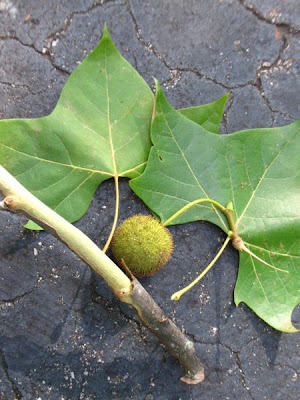
They are very pretty trees, especially in the fall and winter, because the outer bark peels off in great scales to reveal the white wood underneath. Most of the sycamores here have huge leaves with saw teeth around the edges, but the specimen I brought home is one of the less common ones with smaller, smooth leaves.
Actually, these trees aren't sycamores at all, but rather a member of the Plane tree family. In some areas, London Planes, a hybrid between the Platanus Occidentalis and Platanus Orientalis (the one native to India and the Middle East) is commonly used as a landscaping plant. Both P. Occidentalis and P. Orientalis have traditional medicinal uses, so it would be interesting to see how the London Planes might fare in the hands of an interested herbalist.
But, based on the leaf shape, the single fruit per stem, and the location of the one I found the other day, I have a piece of Platanus Occidentalis to play with.

It had been a while since I last read up on this tree. After shredding some twigs, peeling off some inner bark, and installing the bits and pieces into a canning jar full of vodka, I turned my attention to finding more detailed information than what I remembered. (Which was: "Diaphoretic and diuretic. . . I think.")
Here are the sources I turned up with an online search: a USDA Plant Guide ; the University of Michigan's ethnobotany database; and a blurb from Scudder.
The USDA Plant Guide summarized the traditional ethnobotanical uses of P. Occidentalist:
"Ethnobotanic: Native Americans used sycamore for a variety of medicinal purposes, including cold and cough remedies, as well as dietary, dermatological, gynecological, respiratory, and gastrointestinal aids."
The University of Michigan's ethnobotanical database went into a little more detail. Generally, root decoctions were used for gynecological purposes, such as to help expel the afterbirth, and the inner bark was favored for a myriad of other uses.
Among the internal uses for the inner bark:
Topically, a decoction of the inner bark was used for skin eruptions and eczema, to dry up and prevent scarring from smallpox rashes, as a wash for knife and ax wounds, and to bathe infected sores. Additionally, a combination of the bark and roots was used to make a foot soak for rheumatism
There was even a mention of the plant being used 'in a steam bath for indigestion or biliousness', but, once again, the database is a little vague on the specifics.

Scudder had this to say:
"Platanus.
Dose.—Of an infusion of one ounce to a pint of boiling water, from two to six ounces.
The bark and twigs of the Platanus Occidentalis, or Sycamore, is said to be diaphoretic, diuretic, anodyne, and antispasmodic. It is sometimes employed in infusion in the acute exanthematous fevers—as measles, scarlet fever, etc.—when the eruption is slowly or imperfectly developed, or when it recedes. It is used as a diuretic in nephritic affections, calculous irritation, and other diseases of the urinary organs. It has also been used in pertussis, night-sweats, and dysentery, with advantage. We have used a strong decoction of the bark of this and the white oak in night-sweats, the infusion being used internally at the same time."
Also, I found one other pretty cool article on the edible and other miscellaneous uses of American Sycamore is over at this website: Eat The Weeds.
I'm really looking forward to experimenting with the extract I'm making, as well as the more traditional bark and twig decoctions. Has anyone else used this plant or know of anyone who has?
 After the last storm, I discovered a very large downed branch along my favorite walking route near my neighborhood. Dog on one side, massive limb on the other, I wandered home and giggled about all the cars that were slowing down to take a good look at the walking tree!
 They are very pretty trees, especially in the fall and winter, because the outer bark peels off in great scales to reveal the white wood underneath. Most of the sycamores here have huge leaves with saw teeth around the edges, but the specimen I brought home is one of the less common ones with smaller, smooth leaves.
Actually, these trees aren't sycamores at all, but rather a member of the Plane tree family. In some areas, London Planes, a hybrid between the Platanus Occidentalis and Platanus Orientalis (the one native to India and the Middle East) is commonly used as a landscaping plant. Both P. Occidentalis and P. Orientalis have traditional medicinal uses, so it would be interesting to see how the London Planes might fare in the hands of an interested herbalist.
But, based on the leaf shape, the single fruit per stem, and the location of the one I found the other day, I have a piece of Platanus Occidentalis to play with.

It had been a while since I last read up on this tree. After shredding some twigs, peeling off some inner bark, and installing the bits and pieces into a canning jar full of vodka, I turned my attention to finding more detailed information than what I remembered. (Which was: "Diaphoretic and diuretic. . . I think.")
Here are the sources I turned up with an online search: a USDA Plant Guide ; the University of Michigan's ethnobotany database; and a blurb from Scudder.
The USDA Plant Guide summarized the traditional ethnobotanical uses of P. Occidentalist:
"Ethnobotanic: Native Americans used sycamore for a variety of medicinal purposes, including cold and cough remedies, as well as dietary, dermatological, gynecological, respiratory, and gastrointestinal aids."
The University of Michigan's ethnobotanical database went into a little more detail. Generally, root decoctions were used for gynecological purposes, such as to help expel the afterbirth, and the inner bark was favored for a myriad of other uses.
Among the internal uses for the inner bark:
- given in cases of milky urine, or difficult urination with yellow discharge.
- mixed with honey locust bark as a gargle for sore throat and hoarseness and as a drink for colds
- blood purifier
- measles
- dysentery
- internal pain and ulcers
- hemorrhages
- lung troubles: asthma, pulmonary tuberculosis, coughs
- catarrh (copious mucus associated with head colds, chest coughs, and sinus infections)
Topically, a decoction of the inner bark was used for skin eruptions and eczema, to dry up and prevent scarring from smallpox rashes, as a wash for knife and ax wounds, and to bathe infected sores. Additionally, a combination of the bark and roots was used to make a foot soak for rheumatism
There was even a mention of the plant being used 'in a steam bath for indigestion or biliousness', but, once again, the database is a little vague on the specifics.

Scudder had this to say:
"Platanus.
Dose.—Of an infusion of one ounce to a pint of boiling water, from two to six ounces.
The bark and twigs of the Platanus Occidentalis, or Sycamore, is said to be diaphoretic, diuretic, anodyne, and antispasmodic. It is sometimes employed in infusion in the acute exanthematous fevers—as measles, scarlet fever, etc.—when the eruption is slowly or imperfectly developed, or when it recedes. It is used as a diuretic in nephritic affections, calculous irritation, and other diseases of the urinary organs. It has also been used in pertussis, night-sweats, and dysentery, with advantage. We have used a strong decoction of the bark of this and the white oak in night-sweats, the infusion being used internally at the same time."
Also, I found one other pretty cool article on the edible and other miscellaneous uses of American Sycamore is over at this website: Eat The Weeds.
I'm really looking forward to experimenting with the extract I'm making, as well as the more traditional bark and twig decoctions. Has anyone else used this plant or know of anyone who has?
Monday, July 2, 2012
Quick and Easy Elderberry Syrup
Elderberry is a great syrup to have on hand. It has a pleasant taste, and is traditionally used to support the immune system during cold and flu season. July isn't exactly cold and flu season, but fresh elderberries will be ripening soon, so this is the time of year to start thinking about making syrup.
If you have access to fresh elderberries, you can usually boil them down with only a little extra water and the end result will be a very strong juice that makes an excellent syrup. If you only have dried berries, though, the process is a little different. I chose to use dried berries because they are very inexpensive and easily available, and they still make a very nice syrup.
Elderberry syrup can be enjoyed by the spoonful or stirred into a glass of sparkling water, or as a flavored syrup on pancakes, ice cream or whatever strikes your fancy.
Ingredients:
1/4 cup dried elderberries
1 cup distilled water
1 cup honey (preferably raw)
Supplies:
Non reactive saucepan with lid
Fine mesh strainer
Large glass measuring cup
Glass Jar
Metal Spoon
Place elderberries and water into a saucepan and bring to a boil. Remove from the heat, cover with lid and let stand for ten minutes.

Place mesh stainer over the large glass measuring cup and pour berries and juice into the strainer. Use the back of the spoon to press berries against the strainer until most of the juice has been removed and the berries are mostly dry. Discard the mashed berries, and return the juice to the saucepan.

Add the honey to the juice and return the pan to low heat. Stir constantly until the honey and juice are completely mixed. This doesn't take long, only about 30 seconds or so.
Pour into the glass jar and cap tightly, label and date. Store in the refrigerator.
According to Richo Cech in his book Making Plant Medicine, an herbal syrup made with these proportions (1 part by volume of strong herbal decoction or infusion to 2 parts by volume of Honey) can have an expected shelf life of one year if sterilized glass jars are used.

My syrup yielded about 10 oz for less than $5.00. I found twelve ounces of local honey for around four dollars at a farmer's market, and found four ounces of dried elderberries online for $3.50. The bag of elderberries I bought had about two cups worth of dried berries to play with, so I still have enough berries for three more batches of syrup.
To compare, leading brands of elderberry syrup at my neighborhood health food store can cost as much as $20 for 3oz!
Monday, June 25, 2012
Busy Week Ahead!
Last Wednesday was eagerly awaited. I rushed home from barn chores, and then dragged my feet to leave for the waitressing job, listening for the UPS truck. I was waiting ever so patiently- haha, ok, I was jumping up and down on the doorstep like a flying monkey, which got a repeat performance when I came home that afternoon and found that the package had finally arrived.
Yes, I'm a total dork, and I get very excited when I have new herbal supplies. . .
This time, all the excitement was over:
Orange Peel Powder (for Herbal Kitchen Recipes)
Calamus Root (I was curious after reading Jim McDonald's article)
Elderberries (for Recipes and Extracts)
Easy Day Tea (I haven't had much time to mix up my own teas lately, and this one looked delicious!)
Honeybush Tea (really tasty- just be careful not to steep more than two or three minutes, otherwise it looses all the flavor and just tastes astringent)
Twenty-Four 4 oz bottles, with screw top lids (I decided to try these instead of droppers this time. Droppers and I get along less than famously)
Other than the teas, I had to wait until this weekend to dig into the order, so it's been tidily arranged on the counter waiting for me.
Yesterday I was able to press out those extracts that have been lurking beneath my counter since October of last year, and also the Liriodendron extract.
Other than that, I haven't been up to much this past week- at least not herbally speaking. There haven't been any new and interesting weeds begging to be written about, and I haven't done any heavy reading.
I have been very busy on the personal and work front, and it looks like that will continue, but I hope to have good news on that soon!
Have a great week!
Agatha
Yes, I'm a total dork, and I get very excited when I have new herbal supplies. . .
This time, all the excitement was over:
Orange Peel Powder (for Herbal Kitchen Recipes)
Calamus Root (I was curious after reading Jim McDonald's article)
Elderberries (for Recipes and Extracts)
Easy Day Tea (I haven't had much time to mix up my own teas lately, and this one looked delicious!)
Honeybush Tea (really tasty- just be careful not to steep more than two or three minutes, otherwise it looses all the flavor and just tastes astringent)
Twenty-Four 4 oz bottles, with screw top lids (I decided to try these instead of droppers this time. Droppers and I get along less than famously)
Other than the teas, I had to wait until this weekend to dig into the order, so it's been tidily arranged on the counter waiting for me.
Yesterday I was able to press out those extracts that have been lurking beneath my counter since October of last year, and also the Liriodendron extract.
Other than that, I haven't been up to much this past week- at least not herbally speaking. There haven't been any new and interesting weeds begging to be written about, and I haven't done any heavy reading.
I have been very busy on the personal and work front, and it looks like that will continue, but I hope to have good news on that soon!
Have a great week!
Agatha
Subscribe to:
Posts (Atom)