Probably the most familiar herbal preparations for most people are the little bottles of liquid extracts or bottles of capsules available at stores that carry herbal products. However, there are plenty of other options for anyone interested in using herbs at home or stocking an herbal first aid kit. Other options, even, that are less expensive and more versatile.
Starting with bulk dried herbs (some health food stores carry them, or they can be ordered online), a number of simple preparations can be made at home with the addition of a few other ingredients:
Herbs+Water
Makes a "Tea". In herbal-speak, we call this an infusion or decoction depending on the ingredients and the length of time it gets steeped. Herbs+Water can also be used on the skin by applying with a clean cloth and laying over the desired area, or as a soak or bath.
Herbs+Vinegar
Makes an "Herbal Vinegar," or a "Vinegar Extract" depending on the ratio of herbs to vinegar. Herbs+Vinegar can be used topically or internally, and as a flavoring agent in foods or drinks. An Herbs+Vinegar extract can as a substitute for an Herbs+Alcohol extract when alcohol is either not available or not desirable for a situation. Vinegar interacts with herbs somewhat differently than alcohol, and the shelf life is not as long (alcohol extracts, when done well, can last upwards of five years), but hey are still very well suited for the home herbalist.
Herbs+Honey
Makes an "Herbal Honey" or "Electuary." Can be eaten right off the spoon, stirred into water to make a beverage, or rolled into little balls of the appropriate serving size.
Herbs+Oil
Makes an "Infused Oil." Depending on the herbs used, the oil can be used as a cooking ingredient or applied to the skin for skincare purposes. Herbs+Oil+Wax= Salve/Ointment.
Herbs+Alcohol
Herbs+Alcohol usually means Herbs+Grain alcohol, which is the usual composition of herbal extracts available in commerce. Other possibilities for the home herbalist, though, include Herbs+Brandy or Herbs+Wine.
Stay tuned for next week's post: A Guide To Herbal Emergency Preparedness-What Herbs, What Forms, and How Much to Store
Showing posts with label Study Guides. Show all posts
Showing posts with label Study Guides. Show all posts
Monday, September 16, 2013

Monday, September 9, 2013
Twelve Herbs Every Prepper Should Know
Here at the Independent Herbalist, there are twelve herbs that I have fallen in love with over the years for their versatility and common availability. All of these herbs can be grown almost anywhere, and most of them are either native or have naturalized widely in North America (which means they are great candidates for foraging as well as gardening!)
Below, I have made a list of the plants along with a link to the USDA plant database. By following the link, you will be taken to pictures of each plant, range maps of where it grows wild, and a related links tab. Under the related links tab, you can find ethnobotanical information (that's the recorded medicinal uses of Native peoples) and gardening information on each plant. Many of the herbs also have a PDF file put together by the USDA plant database people, but not all- so be sure to check out that related links tab!
There are an incredible range of uses for each of the herbs below, but think of this as an introduction or study guide to help learn how to visually identify each plant and learn a general overview of some historical uses.
Angelica: Angelic archangelica or Angelica atropurpurea (most herbalists consider them interchangeable)
Bee Balm: Monarda fistulosa
Catnip: Nepeta cataria
Dandelion: Taraxacum officinale
Elder: Sambucus nigra or Sambucus nigra spp canadensis (American elder is considered interchangeable with the European Sambucus nigra)
Hawthorn: Crataegus monogyna
Lemon Balm: Melissa officinalis
Mullein: Verbascum thapsus
Peppermint: Mentha x piperita
Rose: Rosa canina
Valerian: Valeriana officinalis
Yarrow: Achillea millefolium
The USDA Database is a wonderful resources for many other plants as well- just bear in mind you need to have the scientific binomial for the plants you want to research (ie 'Taraxacum officinale' vs Dandelion). It can be a bit fiddly, but it's well worth it!
Stay tuned, our next post will be: Herbs+What?: The Quick Guide to Herbal Preparations
Monday, July 16, 2012
American Sycamore (Platanus Occidentalis)
American Sycamore, Platanus Occidentalis, has fascinated me ever since I was a little kid. Once, a long time ago, I saw the trees across a wide field by a river, and hoped for a chance to see them up close. Wish granted, when I moved here I suddenly found the trees all around me - especially by the river at what quickly became my favorite local park.
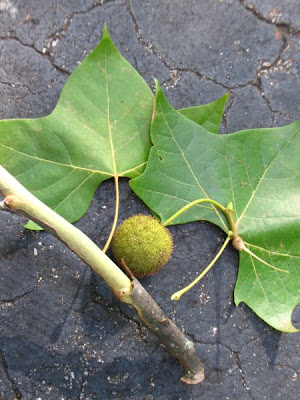 After the last storm, I discovered a very large downed branch along my favorite walking route near my neighborhood. Dog on one side, massive limb on the other, I wandered home and giggled about all the cars that were slowing down to take a good look at the walking tree!
They are very pretty trees, especially in the fall and winter, because the outer bark peels off in great scales to reveal the white wood underneath. Most of the sycamores here have huge leaves with saw teeth around the edges, but the specimen I brought home is one of the less common ones with smaller, smooth leaves.
Actually, these trees aren't sycamores at all, but rather a member of the Plane tree family. In some areas, London Planes, a hybrid between the Platanus Occidentalis and Platanus Orientalis (the one native to India and the Middle East) is commonly used as a landscaping plant. Both P. Occidentalis and P. Orientalis have traditional medicinal uses, so it would be interesting to see how the London Planes might fare in the hands of an interested herbalist.
But, based on the leaf shape, the single fruit per stem, and the location of the one I found the other day, I have a piece of Platanus Occidentalis to play with.

It had been a while since I last read up on this tree. After shredding some twigs, peeling off some inner bark, and installing the bits and pieces into a canning jar full of vodka, I turned my attention to finding more detailed information than what I remembered. (Which was: "Diaphoretic and diuretic. . . I think.")
Here are the sources I turned up with an online search: a USDA Plant Guide ; the University of Michigan's ethnobotany database; and a blurb from Scudder.
The USDA Plant Guide summarized the traditional ethnobotanical uses of P. Occidentalist:
"Ethnobotanic: Native Americans used sycamore for a variety of medicinal purposes, including cold and cough remedies, as well as dietary, dermatological, gynecological, respiratory, and gastrointestinal aids."
The University of Michigan's ethnobotanical database went into a little more detail. Generally, root decoctions were used for gynecological purposes, such as to help expel the afterbirth, and the inner bark was favored for a myriad of other uses.
Among the internal uses for the inner bark:
Topically, a decoction of the inner bark was used for skin eruptions and eczema, to dry up and prevent scarring from smallpox rashes, as a wash for knife and ax wounds, and to bathe infected sores. Additionally, a combination of the bark and roots was used to make a foot soak for rheumatism
There was even a mention of the plant being used 'in a steam bath for indigestion or biliousness', but, once again, the database is a little vague on the specifics.

Scudder had this to say:
"Platanus.
Dose.—Of an infusion of one ounce to a pint of boiling water, from two to six ounces.
The bark and twigs of the Platanus Occidentalis, or Sycamore, is said to be diaphoretic, diuretic, anodyne, and antispasmodic. It is sometimes employed in infusion in the acute exanthematous fevers—as measles, scarlet fever, etc.—when the eruption is slowly or imperfectly developed, or when it recedes. It is used as a diuretic in nephritic affections, calculous irritation, and other diseases of the urinary organs. It has also been used in pertussis, night-sweats, and dysentery, with advantage. We have used a strong decoction of the bark of this and the white oak in night-sweats, the infusion being used internally at the same time."
Also, I found one other pretty cool article on the edible and other miscellaneous uses of American Sycamore is over at this website: Eat The Weeds.
I'm really looking forward to experimenting with the extract I'm making, as well as the more traditional bark and twig decoctions. Has anyone else used this plant or know of anyone who has?
 After the last storm, I discovered a very large downed branch along my favorite walking route near my neighborhood. Dog on one side, massive limb on the other, I wandered home and giggled about all the cars that were slowing down to take a good look at the walking tree!
They are very pretty trees, especially in the fall and winter, because the outer bark peels off in great scales to reveal the white wood underneath. Most of the sycamores here have huge leaves with saw teeth around the edges, but the specimen I brought home is one of the less common ones with smaller, smooth leaves.
Actually, these trees aren't sycamores at all, but rather a member of the Plane tree family. In some areas, London Planes, a hybrid between the Platanus Occidentalis and Platanus Orientalis (the one native to India and the Middle East) is commonly used as a landscaping plant. Both P. Occidentalis and P. Orientalis have traditional medicinal uses, so it would be interesting to see how the London Planes might fare in the hands of an interested herbalist.
But, based on the leaf shape, the single fruit per stem, and the location of the one I found the other day, I have a piece of Platanus Occidentalis to play with.

It had been a while since I last read up on this tree. After shredding some twigs, peeling off some inner bark, and installing the bits and pieces into a canning jar full of vodka, I turned my attention to finding more detailed information than what I remembered. (Which was: "Diaphoretic and diuretic. . . I think.")
Here are the sources I turned up with an online search: a USDA Plant Guide ; the University of Michigan's ethnobotany database; and a blurb from Scudder.
The USDA Plant Guide summarized the traditional ethnobotanical uses of P. Occidentalist:
"Ethnobotanic: Native Americans used sycamore for a variety of medicinal purposes, including cold and cough remedies, as well as dietary, dermatological, gynecological, respiratory, and gastrointestinal aids."
The University of Michigan's ethnobotanical database went into a little more detail. Generally, root decoctions were used for gynecological purposes, such as to help expel the afterbirth, and the inner bark was favored for a myriad of other uses.
Among the internal uses for the inner bark:
- given in cases of milky urine, or difficult urination with yellow discharge.
- mixed with honey locust bark as a gargle for sore throat and hoarseness and as a drink for colds
- blood purifier
- measles
- dysentery
- internal pain and ulcers
- hemorrhages
- lung troubles: asthma, pulmonary tuberculosis, coughs
- catarrh (copious mucus associated with head colds, chest coughs, and sinus infections)
Topically, a decoction of the inner bark was used for skin eruptions and eczema, to dry up and prevent scarring from smallpox rashes, as a wash for knife and ax wounds, and to bathe infected sores. Additionally, a combination of the bark and roots was used to make a foot soak for rheumatism
There was even a mention of the plant being used 'in a steam bath for indigestion or biliousness', but, once again, the database is a little vague on the specifics.

Scudder had this to say:
"Platanus.
Dose.—Of an infusion of one ounce to a pint of boiling water, from two to six ounces.
The bark and twigs of the Platanus Occidentalis, or Sycamore, is said to be diaphoretic, diuretic, anodyne, and antispasmodic. It is sometimes employed in infusion in the acute exanthematous fevers—as measles, scarlet fever, etc.—when the eruption is slowly or imperfectly developed, or when it recedes. It is used as a diuretic in nephritic affections, calculous irritation, and other diseases of the urinary organs. It has also been used in pertussis, night-sweats, and dysentery, with advantage. We have used a strong decoction of the bark of this and the white oak in night-sweats, the infusion being used internally at the same time."
Also, I found one other pretty cool article on the edible and other miscellaneous uses of American Sycamore is over at this website: Eat The Weeds.
I'm really looking forward to experimenting with the extract I'm making, as well as the more traditional bark and twig decoctions. Has anyone else used this plant or know of anyone who has?
Monday, June 18, 2012
Wild Carrot (Daucas Carota)
Wild Carrot, Daucus Carota, is a very common weed in my part of the world. It's also known as Queen Anne's Lace. Surprise, surprise, it's not native, and comes from Europe originally. Actually, I was surprised, although I'm not really sure why. I knew that quite a few of the other "southern" weeds come from elsewhere. Maybe it's because this one seems so un-exotic compared to mimosa and honeysuckle.

Another surprise was that only one of my herbal books had anything to say about Queen Anne's Lace. Matthew Wood's book, The Book of Herbal Wisdom, has a brief chapter on this plant. It's much more common in older literature, and I found useful references in King's American Dispensatory, Scudder's American Eclectic Materia Medica and Cook's The Physiomedical Dispensatory. Grieve's A Modern Herbal echoes most of what is found in the other older sources, although she was writing in the 1930's rather than the late 1800s, so her language is much more direct and uncomplicated.
Modern herbalists seem to prefer the immature seeds and the flowering tops before they have gone to seed, and occasionally use the roots. I found only one instance of the leaves being used, which was in A Modern Herbal, and mentioned that the leaves could be combined with honey and applied to weeping sores. The seeds are by far the most common portion of the plant used, both historically and presently.
The seeds have three main classifications of use: as a carminative, as a diuretic, and as a rather complex women's herb. Infusions and extracts seem to be the preferred methods of preparation. Preparation and common use ranges from a teaspoon to a cup of water just brought off the boil, to an ounce of seed per pint of water consumed over the course of the day. Chewing the seeds or adding ground seeds to honey or nut butter is also an option.
Scudder comments on the seeds:
"The seeds are diuretic, stimulant, aromatic and carminative, and are used in nephritic diseases, gravel, irritution and inflammation of the bladder and urethra, suppression of urine, dysuria from blisters and other causes, gonorrhoea, dropsy, etc."
Matthew Wood confirms modern herbalists' experience with Wild Carrot as a carminative, diuretic, and an aid in removing sediments in the bladder and kidneys. Because of this influence it can be useful to restore the body's balance in cases of kidney stones, gout and rheumatism.
He also relates that women have used the seeds to regulate the menstrual cycle. The main influences appear to be an ability to regulate heavy flow, curb the excessive growth of the uterine membrane, and aid against clotting. And yet, here is where the full complexity of this plant as a women's herb comes to light. Although it has a toning influence on the uterine lining overall, some women have successfully used the herb in natural family planning.
In fact, herbalist Robin Rose Bennett organized a small herbal study on Wild Carrot, which can be found here. She includes information on the most common ways to take Wild Carrot for natural family planning and outlines how it was used by the women in the study. There is also an analysis of pregnancies that occurred during the study and whether or not Wild Carrot was being used as suggested in those instances. Although the study was small, with only thirty participants, it is very interesting to read.

That sums up the seeds, but what about the roots? Cook has the most to say about the roots:
"The boiled roots also act on the kidneys; and form an excellent emollient and gently stimulating poultice in irritable ulcers of all grades. But the fresh and unboiled roots, finely grated, make a peculiar stimulating application of great value. They are excellent in all low forms of sores; such as carbuncles, degenerate abscesses, and buboes; and all fetid ulcers of the malignant, cachectic, and scrofulous grades."
So, according to him, boiled roots are a diuretic and they also are a softening (emollient) poultice on skin ulcerations when applied topically. Scudder mentions that the boiled roots make a good poultice for burns and "inflamed surfaces". But the fresh, grated roots seem to make a better topical application as far as Cook is concerned:
" They correct the fetor, relieve the aching, and quickly promote sound granulation. It is said that they will even abate the suffering of phagedaena and of cancer. They certainly deserve far more attention than they have received from the profession; and sores in which it seems impossible to arouse a healing process by ordinary means, will usually improve at once under this application. The raw carrots are not to be continued after full vital action in the part has been established."
As usual, some translation is useful when dealing with older herbal texts. "Phageadaena" is a type of rapidly spreading ulcer. By "fetor" Cook means a foul odor emanating from a wound or sore, and "granulation" is the step in healing when the body begins the process of filling in the sore with new tissue.

Not bad for another USDA "noxious weed". If you choose to harvest your own Wild Carrot, be sure to use a reliable field guide to help you identify. Considering that Wild Carrot could be easily confused with Poison Hemlock, accurate identification is not something to take lightly. Some points to check for are the red flower in the center, the correct leaf shape and the hairy stems.
Wild Carrot loves to grow along roadsides, and this is not an ideal place to harvest from no matter how healthy the plants may look- they can easily pick up all kinds of noxious wastes and heavy metals that have leaked into the soil from storm run off.
If you choose to plant this lovely little weed in your garden, beware that it hybridizes with domestic carrot varieties. This might influence the properties of the Wild Carrot seed, and will definitely put a crimp in your heirloom carrot seed-saving plans unless you grow one or the other in isolation.
Tuesday, June 12, 2012
Albizia Pictures

This is a close up of one of the main branches. The bark has a very distinctive texture.

And here is a pic with the flowers, bark and leaves:

Monday, June 4, 2012
Mimosa (Albizia Julibrissin)
The mimosa trees are in full bloom this week! I've never had a chance to work with these trees even though they are quite common in our area, so it has been great fun to see them up close at
the barn where I work. The
ponies also seem
to like them. The other morning it looked rather like we had a
paddock full of giraffes, because they have eaten all the easy to reach
bits of leaf and flowers but just won't give up on the hopes of another
nibble!
As far as appearances go, Albizia julibrissin trees are easy to miss unless they are blooming. They are small, skinny trees with fern-like leaves that fold up at night or when it rains. They lose their leaves in the fall and usually look a bit skeletal without them. But when an Albizia tree is blooming, it's another matter: they have big, puffball blossoms that usually come in bright, cheery pink and white, and they smell heavenly! The blossoms remind me a little of gardenias, but mostly like peach soda.
This tree originally came from Asia, and was introduced into other parts of the world as an ornamental. In our part of the world (Southeastern US) it has naturalized in many areas, much like that other escaped ornamental, honeysuckle. So pretty, so invasive, so incredibly useful!
Herbally speaking, the blossoms and the bark are considered to be the useful parts of the plant. Traditionally, it was viewed as a sedative with special affinity for emotional disturbances such as anxiety and testiness from bottling up the emotions.The flowers were seen as having a more uplifting action on the emotions, and the bark as having a more grounding effect. Other uses included insomnia, poor memory, and amnesia. Additionally, the bark had another use more related to the physical body: it was considered to be extremely valuable for many types of injuries, including wounds and bone fractures.
I'm hoping I will have some pics of this lovely plant by next week- I keep forgetting to take my camera with me to work. (I know, I know, Bad Plantparazzi!) In the meantime, here's a link to a really great article on Albizia over at the East West School of Herbology's website:
Albizia: The Tree of Happiness by Michael Tierra L.Ac, O.M.D.
Monday, May 7, 2012
Honeysuckle (Lonicera Japonica)

This beautiful flower is from a Honeysuckle vine, lonicera japonica, or Japanese Honeysuckle. Although there are several species of native honeysuckle that grow throughout North America, this is the honeysuckle most people are familiar with. It has a heady aroma and flashy appearance that attract attention.
Although it was innocently introduced in the 1800s as a garden ornamental, this plant has made its way onto the USDA's invasive weed list, maligned for its habit of smothering and wreaking havoc on native plant habitat. Birds love the little blue-black berries that appear on the vines in the fall, and are generally the main carriers of the seeds, spreading them out over large areas.
Surprisingly, this beautiful nuisance has a hidden artistic talent. How about some honeysuckle paper and ink? Patterson Clark, who writes the Washington Post column Urban Jungle, is a visual artist who searches out invasive plants around DC. He takes the plants back to his studio, where he processes them into paper and ink to use in his artwork. American Craft Magazine wrote an interesting article on what he does, and his website is here at Alienweeds. According to Clark, the leaves of honeysuckle make a greenish black ink, and the inner bark of the stems makes a golden yellow paper.
But honeysuckle doesn't stop there. It's a useful member of the traditional herbal community as well! According to Traditional Chinese Herbalism, Vol 2, by Michael and Leslie Tierra, the young stems of honeysuckle are useful for supporting joint health in cases of arthritis and rheumatism, while the flowers are used across a broad spectrum of Heat* disorders.
Plus, most herbalists here in the south could easily pick a basketful of the flowers to make their own extract, and do native plants a favor in the process. Honeysuckle could also be used as a substitute for traditional Heat clearing herbs such as goldenseal and echinacea, which both face over-harvesting pressure and should be carefully obtained through companies with sustainable harvest practices when used.
*Herbalists use the term Heat to describe the human body being out of balance in a way that might be expressed as fever, inflammation, soreness, redness, pain, swelling, or abcesses.
Monday, April 30, 2012
Tulip Poplar (Liriodendron Tulipifera)

Tulip Poplar, Tulipifera Liriodendron, is one of the most strangely beautiful trees of the southeast, thanks to it's elegant growth habits and rather bizarre flowers. The trees grow very tall and straight, and have slightly drooping branches with broad, uniquely shaped leaves. There were several old tulip trees in my backyard when I was a kid. The twigs had a sweet, mysterious scent that I loved.
Revisiting the trees this year, I was intrigued again by the smell of the fresh twigs. I wondered if these magnificent trees have an herbal tradition behind them.

In fact, they do. All parts of the tree, from leaves to seeds to bark to root, seem to have been employed at least some of the time, but the inner bark or root seem to have been the most popular.
The tree seems to have been used in a lot of different ways: as a nervine, tonic, stimulant, anthelmentic, febrifuge, anti-rheumatic, gastrointestinal aid, and anti-diarrheal.The bark was used for intermittent fevers, and it was sometimes used as a substitute for cinchona.
(By the way, cinchona is the stuff that the tonic water of gin-and-tonic fame was originally made of, so of course now I'm wondering what a Tulip Tree gin and tonic would taste like. Sounds like a fun experiment to me!)
Other uses included an ingredient in cough syrup and as a wash or poultice for wounds and broken bones.
From what I read, Cook, in The Physiomedical Dispensatory, 1869, sums up it's uses in the Eclectic literature very nicely:
"The bark of the liriodendron is one of the mildest and least bitter of the tonics, chiefly relaxant and only moderately stimulant, but with no astringency whatever. While it improves the appetite and digestion to a fair extent, and for this purpose is unsurpassed in convalescence, its most valuable action is upon the nervous system and uterus. In nervousness, nervous irritability, hysteria, and chronic pains through the womb, it is an agent of the greatest efficacy–both soothing and sustaining. The menses are not influenced by it; but it proves valuable in chronic dysmenorrhea as well as in leucorrhea, prolapsus of a mild grade, and the uterine suffering incident to pregnancy. By its influence on the nervous system it sometimes promotes the flow of urine; and it favors greater freedom of the bowels, without being in any sense cathartic. If combined with spikenard, boneset, or other agents influencing the lungs, its virtues will be directed largely to these organs; and then is of peculiar service in old coughs and pulmonary weakness. The mildness of its action sometimes suggests inertness, but this is quite an error; for its gentleness increases its value as a peculiar nervine tonic, and makes it very acceptable to the stomach; though it is not an agent fitted to languid or sluggish conditions, or states of depression."
Translation: Cook thinks it useful for certain female problems, as a digestive tonic useful for improving the appetite and digestion after illness, and that it has very gentle but effective actions on the nervous system. He also states that if it is used with lung supporting herbs it helps with old coughs and helps strengthen the lungs.
Scudder, in Specific Medication and Specific Medicines, 1870, stated that
"It is stimulant and tonic to the digestive apparatus, improving digestion and blood making. It also exerts an influence upon the nervous system, strengthening innervation and relieving those symptoms called nervous."
So, Scudder seconds that it is a nervine and useful as a digestive aid.
I would love to work with this tree when I get the chance. It's not available from any commercial sources that I can tell, so it will have to go on my wild crafting wish list for the time being. I'm sure some of the trees behind my parents' house will drop a few limbs before the summer is over- that seems to be typical for them when summer storms come through, if I remember correctly. Interestingly, the Eclectics believed it could be effectively extracted in either alcohol or with cold water, but that boiling destroyed its active principles.

King's American Dispensatory and Lloyd's Drugs and Medicines of North America have more great info on Tulip Tree, and thanks to Henriette's Herbal web page and blog, they are available to read for free online.
Also, one of my other standby online references, the University of Michigan's ethnobotanical database, turned up a good general list of historical uses: just type 'liriodendron' into the search box to repeat the search.
Monday, April 23, 2012
Black Willow (Salix Nigra)

When most herbalists think about willow, they think about white willow, Salix alba, which is easy enough to find at health food stores. Otherwise, the word 'willow' might conjure up images of the graceful landscape tree with long trailing branches. That would be weeping willow, or Salix babylonica. Very few people are aware of our native willow species, Salix nigra, or its herbal history.
Black willows have a much less dramatic appearance than the familiar and flamboyant weeping willows. Still graceful, but much more upright and slender. They love to keep their feet wet, and the ones I spend time around have grown up amongst white oak, tulip trees, maples and sweet gums in an area near a small creek. They are currently in their seed-setting stage, so there is a great deal of fluff wandering about in the air. I find it rather playful and endearing, although my friends have explained to me that it is, in fact, a Dreadful Nuisance.

Although it isn't much used by herbalists now, black willow was used by the Eclectic physicians, and appears in several of their Materia Medica reference books.
According to King's American Dispensary (1898), the bark, root and aments (the long, drooping clusters of flowers) were all used for certain purposes.
Similar to white willow, the bark of black willow contains salicin and tannins. It was used to make poultices for gangrene and ulcers, and also to make a cream for the rash caused by poison ivy.
The root was used as a bitter tonic, taken internally for "intermittents" (recurring fevers), asthma, or gout.
Interestingly, the aments are cited as being used to make the preferred preparation of black willow. This is very different than white willow, where only the bark seems to have been favored. The aments, like the bark, were cited as being beneficial for gangrene. However, their main use seemed to be as an anaphrodisiac. Considering the time period in which the Dispensary was written, we find such language as
"it is especially adapted to the disorders of the sexually intemperate male or female, and of the youth, subject day or night to libidinous suggestions and lascivious dreams terminating in pollutions. . ."
The Dispensary goes on to amend that:
"Not only does salix nigra act as a check to sexual passion and misuse, but it proves a useful tonic and sedative to many conditions following in the wake of sexual intemperance, among which may be mentioned spermatorrhoea its varied forms, and prostatitis, cystitis, and ovaritits."
All of which would strongly suggest that, Victorian prudishness aside, the herb has an effect on the central nervous system, and also that it has cooling actions in the body with an affinity to the reproductive organs.
In fact, Ellingwood, in The American Materia Medica (1919), had this to say about black willow:
"It will exercise a direct and satisfactory influence in many cases of hysteria, overcoming the extreme excitability and nervousness, headache and the globus hystericus, and will permit quiet, restful sleep. It will serve an excellent purpose in these cases in combination with general nerve tonics and restoratives, greatly enhancing their influence."
So it looks like it could be a very useful herb to add to nervine blends or central nervous system tonics.

Ellingwood also mentioned the use of the aments rather than the bark.
It looks like all of our willows have gone to seed, so I suppose I will have to wait until next year to make an extract. Might be able to make a salve or cream from the bark though- which would be good to have on hand because we have plenty of poison ivy to go around! Who knows, though? I might be able to find a late bloomer or two.
Monday, November 7, 2011
So Many Herbs. . .
Hundreds of plants fill the pages of herbal books and supply
catalogs, and the amount of information can be exciting and overwhelming. It is
better to know a lot about a few herbs than to know a little about many, but how
does an aspiring home herbalist choose which herbs to learn about first? How should a home herbalist decide which herbs
to grow or purchase for personal and family use? Making a single list for both
purposes works surprisingly well.
A list of herbs should be based around the interest of the herbalist, but it is helpful to decide on a general topic. Considering herbs by geographic location or tradition can be
easy ways to come up with a list. Geography can be general (rainforest herbs,
desert herbs, forest herbs) or related to country, or the list could be focused
on herbs that are native to the area in which the herbalist lives. Herbal traditions
to consider include Ayurveda, Traditional Chinese, Unani, or Native American.
Then again, the list could be based on clustering the herbs around
traditional uses. To use this approach, select herbs which were used traditionally to
support the heart, the lungs, the digestive tract, or other organ systems. An
aspiring herbalist could also focus on herbs which have traditionally been used
as support for any health challenges they might be facing personally.
After a guiding topic
for the list is decided upon, the list itself can be made from the herbs discovered
in the initial research. The list doesn’t have to be long or complicated. For
example, focusing on one to three herbs at a time from a longer list of twelve
keeps all the information from running together, but also gives the herbalist a
long term study goal.
Once some time has been devoted to studying the herbs on the
list, it will be easier to decide which ones to grow or purchase for personal
and family use. Research information related to safety when studying each herb,
such as potential toxicity, interactions with medications or health conditions,
and how to correctly identify the herb. If an herb doesn’t seem like a good fit
based on safety data, consider excluding it from purchase. Also, find out if
the herb is commonly cultivated or is facing pressure from over harvesting.
Make sure the herb is available from sources that cultivate the herb
themselves, or work closely with their growers to guarantee that herbs are ethically
harvested. If it isn’t available from reputable sources, seek out an
alternative herb.
Remember, knowing a few herbs really well (including how to
identify them by sight, what they taste and smell like, any interactions they
could have with prescription or over the counter medication) and being able to
turn to them with confidence is much better than having a vague idea or an
inkling about dozens of herbs, for practical as well as safety reasons. Developing a single list of herbs to study and purchase can help aspiring herbalists focus on using herbs safely at home. So, do
some reading, make a list, and have fun!
Monday, October 17, 2011
The Herbalist's Spectra
"Being an Herbalist" has almost as many finer shades of color as there are herbalists to paint the picture.
Also similar to color, many of the concepts herbalists use to describe themselves can be organized along a spectrum with very different world-views described at each end.
While helping to describe what being an herbalist is like, the spectra can also be viewed as a tool for the overview of potential within the study of herbalism. An herbalist who finds that they align most closely with one side of a spectrum can introduce new ideas and concepts by taking some time to work at the other end.
The main spectra which I have observed are along the lines of the following: Theory Orientation, Source of Botanical Materials, Style Orientation, and Educational Background.
Herbalists don't necessarily fall on the same end off all spectra, although I have grouped them according to which values seem to be most consistently selected among proponents of Western vs Eastern philosophy. Values and views which western style herbalists seem to appreciate are on the left, values and views seemingly appreciated by eastern style herbalists are on the right.
As far as I can tell, herbalists can (and do) also select from various points along each spectrum, which gives even more options.
Theory Orientation: Western ------ Eastern
Source of Botanical Materials: Local ------- Global
Style Orientation: Folk------Clinical
Educational Background: Self Taught -------School Graduate.
Here is more information about the categories and their spectra:
Theory Orientation
Western Theory is typically based around traditional Greek and Roman medical concepts and the Eclectic traditions of early American physicians, such as the humors and matching herbs with people by way of very specific symptom pictures. The symptom pictures include very detailed information on the emotional state as well as physical state. Eastern Theory favors detailed description of energy patterns within the body and the working relationships of the five elemental organ systems, which are generally described in terms of parent - child or grandparent-grandchild relationships. The parent - child relationship describes which element systems nourish each other, while the grandparent-grandchild relationship explains how the elements are a controlling influence on one another. The systems are not mutually exclusive, however, and a great deal can be learned hovering about the middle of the spectrum and absorbing information from each.
Source of Botanical Materials
Local source proponents tend to grow or wild craft all of their own material, preferring plants which are in the immediate vicinity of where the herbalist lives. They like to have intimate knowledge of the ecological impact of harvesting the plants they use, and often engage in habitat restoration, creating botanical sanctuaries, and tending the remaining plants by weeding out invasive species and helping to distribute seeds. Native plants are often favored over plants from other areas or countries. Herbalists with a more global penchant often use herbs from around the world, such as in the case of Ayurvedic or Traditional Chinese formulas. Rainforest herbs are another example of the herbs a global herbalist might seek out.
Style Orientation
Folk herbalists are more likely to use simpling (use of a single herb rather than a complex formula), be more interested in exploring traditional uses of local plants, and see themselves as kitchen or informal herbalists. This is not to say that their knowledge or experiences are in anyway inferior to those of a more formal clinical herbalists. Rather, that the knowledge and experiences are of a different, and generally complementary, sort. Clinical herbalists may define themselves as such because they work in a medical setting, under the supervision of and as consultants for MDs. Or, they may simply be trying to express their affinity for studying the chemical actions and building blocks of plants in a more structured and formally scientific way.
Educational Orientation
At the left end of the educational spectrum are the self taught or informally apprenticed herbalists. Self taught herbalists may use a combination of books, hands on work, and workshop attendance to further their skills. Moving towards the right are the many and diverse herbal schools developed by experienced herbalists after many years of honing their own skills, and these schools have various levels of intensity and formality according to the personality of the founding herbalist. At the extreme left are the graduates of a Naturopathic program (ND) of formal, rigorous study in a university setting.
Again, there are many herbalists who will identify at various points along each spectrum, but I hope that this will be a good overview about what being an herbalist can mean, as well as useful tool in exploring the full potential of herbalism.
Subscribe to:
Posts (Atom)